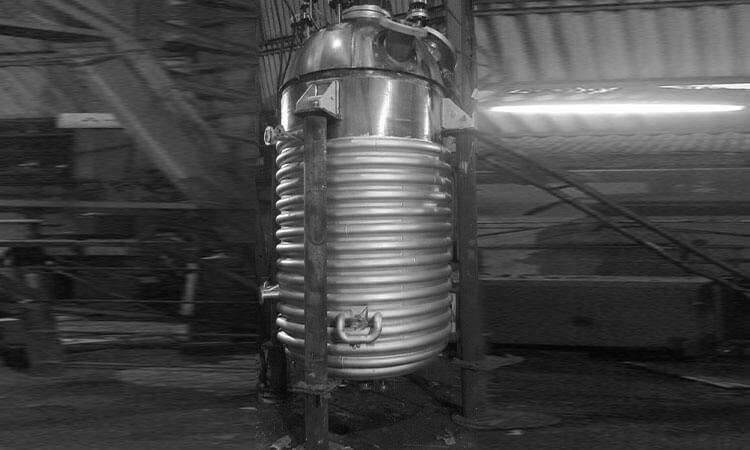
Gas Liquid Reactions – An Introduction
Gas-liquid reactions are very common in Chemical Process Industry and contribute to more than 30% of all the chemical commercial reactions. There are several commercially important reactions where the gas phase is pure/explosive/toxic. In all these cases the gas phase is expensive and complete utilization of the solute gas is desired. When gas is introduced into the liquid, it has a certain residence time after which it leaves the liquid phase and is lost to atmosphere. To prevent this, there are often recovery devices attached in series with gas liquid contactors. However, this requires additional cost of installation of recovery devices and operating costs from recovering, pumping and compressing of recovered gas. The problem of retaining gas within the reactor has been achieved in the recently developed novel reactor design (which is patented). It uses the self induction principle for impellers. Energy efficient impeller designs have been developed for gas induction and gas dispersion. It is also efficient for gas-liquid-solid three phase reactions. The solid phase may be a catalyst or undergo a chemical reaction. The solids concentration may vary from 0.005% v/v (in the case of noble metal catalyst ) or 25% v/v (when solids undergo chemicals reaction). It is a proven design and a large number of reactors are in successful Commercial operation with a size range from 500 to 20,000 liters. This Gas Liquid Induction Reactor (Hydrogenator) is manufactured in India by New Multifab Engineers Private Limited and finds application in a variety of industrial applications.
Hydrogenation Reaction – An introduction
Reactions in which hydrogen is simply added to a molecule are clubbed under the category of “Hydrogenation” Reactions. Hydrogenation is synonymous with reduction. Advantages of hydrogenation over conventional reduction reaction:
- Simpler and more useful procedure, with high yield
- Cleaner products
- Large volumes of solvents and/or solutions not required in processing step – particularly useful when process has to be used commercially
- Suitability to scale up – lab scale to commercial production
Catalytic hydrogenation is widely used in laboratory and industrial processes. Principal usage in laboratory is for chemical syntheses and also as a research tool. Industrial applications are varied: a short list of Clients to whom we have supplied Hydrogenators can be seen below. There are various limiting steps for the reaction, however there are some 8 kinetic resistances which have to be overcome for undertaking a hydrogenation reaction with high yield percentage.
Hydrogen side resistances
- Solution of Hydrogen
- Diffusion to Catalyst
- Chemisorption on Catalyst
Fluid side resistances
- Diffusion to Catalyst
- Chemisorption on Catalyst Other resistances
- Surface reaction on Catalyst
- Desorption of Products from Catalyst
- Diffusion of Products from Catalyst to Liquid phase
Of the above resistances, the chemical reaction kinetic resistances can be tackled by proper selection of catalyst and reaction conditions. However, it is often found that the rate of dissolution of hydrogen in the liquid phase is the rate limiting step. This is where the Hydrogenators manufactured by New Multifab Engineers Private Limited score over other similar process vessels. The key feature of these reactors is the efficiency at which gas – liquid mixing occurs. For this purpose, it is important that the unreacted gas from the gas space is drawn back into liquid. This difficult task has been achieved in the recently developed novel reactor design (which is patented). It uses the self induction principle for impellers. Energy efficient impeller designs have been developed for gas induction and gas dispersion. It is also efficient for gas-liquid-solid three phase reactions. The solid phase may be a catalyst or undergo a chemical reaction. The solids concentration may vary from 0.005% v/v ( in the case of noble metal catalyst ) or 25% v/v (when solids undergo chemicals reaction). It is a proven design and a large number of reactors are in successful Commercial operation with a size range from 500 to 20,000 liters.
We have manufactured Hydrogenators in various sizes. Click on the image to expand it:
These are in use in various industries across India.
Some typical applications of Hydrogenators manufactured and commissioned by us are as follows:
| No. | Application | Range of Reactor Volume | Product Category |
| 1 | Saturation of double bonds. For example, in this case parafins are formed from olefins or saturated fatty acids or saturated oils from the corresponding unsaturated acids and oils. | 5 m3 – 20 m3 | Fatty acids, Hydrogenation (or hardening) of natural oils |
| 2 | Nitrile to amine. In this case C = N group is converted in to -CH2 NH2. | 0.1 m3 – 8 m3 | Soap Intermediates and Specialty chemicals |
| 3 | Saturation of aromatic ring. The ring of of substituted aromatic compounds are saturated | 0.5 m3 – 4 m3 | Substituted anthraquiones, speciality chemicals, perfumery chemicals, cyclohoxyl amine |
| 4 | Hydrogenation of aromatic nitro-compounds such m-dinitrobenzene, o-nitroanilene, p-nitoanilene, o-dinitrobenzene, p-dinitrobenzens, nitrotoluenes, nitroxylenes, nitrochlorobenzenes, nitroanisoles, nitrocumenes, etc. | 2 m3 – 12 m3 | Dye, pharmaceuticals and agro-chemical intermediates |
| 5 | Reductive amination and reductive alkylation | 1 m3 – 5 m3 | Surface active agents, Pharmaceutical intermediates |
Our Engineering Strengths
The company offers process and mechanical design of custom built equipment under one roof. In house quality assurance practices are followed.
Application of Hydrogenation
1. Aliphatic compounds with one or multiple of double/triple bonds
2. Conversion of Aromatic compounds from Nitro to Amino
3. Conversion of Aliphatic & Aromatic compounds from Cyno to Amines
4. Conversion of Aliphatic & Aromatic compounds from Acids to Aldehydes
5. Conversion of Aliphatic & Aromatic compounds from Aldehydes to Alcohols
6. Rind hydrogenation of variety of aromatics
7. Reductive amination
8. Reductive Alkylation
9. Asymmetric hydrogenation
Our Commitments / Responsibility
We offer a single source responsibility from process / product development stage through design, procurement, construction and commissioning of plant. We shall be part of your team during execution of project – conception to commissioning.
Depending on the reaction, our Gas Induction reactor along with process engineering of the hydrogenation system, one or more of the following objectives / goals can be achieved:
- Shorter reaction time
- Higher selectivity
- Higher yield
- Reduced catalyst load
- Reduced catalyst consumption due to more number of recycles
- Higher productivity
Reduced solvent load if solvent is used as reaction media leading to higher productivity per unit volume of reactor.
Hydrogenation with Gas Induction Reactor – Stirred Vessel (Hydrogenator)
The benefits of gas induction reactor are as follows:
- Complete and Vigorous mixing of gas and liquid
- Uniform suspension of catalyst throughout reaction mixture
- Large gas-liquid contact area, typically 200m2 per m3 of operating volume
- Enhanced rate of mass transfer
- Minimal side reactions
- Reduced reaction time
- Higher heat transfer co-efficient
- Better batch to batch repeatability
- Heat transfer area not a constraint – Heat transfer area can be provided by internal coil as well as external heat exchanger
Hydrogenation with Hydrosyphon System
To overcome limitation of accommodating heat transfer area in stirred vessel, the alternate design is providing an external heat exchanger with recirculation pump.
Our in-house developed hydrogenation system design is without recirculation pump based on Hydrosyphon principle. In this design, heat transfer area is provided out side the vessel as vertical shell & tube heat exchanger.
In this design Hydrosyphon can generate volumetric flow rates equivalent to large size pumps used for re-circulation providing advantage of elimination of rotating parts there by eliminating mechanical maintenance as well as hydrogen embrittlement of metal. Additionally, since our design does not require installation of pump, the power consumption of system is reduced. Hence, this is an eco-friendly solution.
Hydrosyphon system can be designed for high turn-down ratio, even by factor of ‘five’.
Our Services
- Optimization of catalytic gas/liquid reactions
- Development of specific process
- Providing guidance for handling of all types of catalyst used for hydrogenation like noble metals, Pt/C, Pd/C, Rh-Ni etc.
- Providing guidance for reactivation and reuse of spent catalyst
- Providing guidance for regeneration and reuse of spent catalyst
- Feasibility study & site assessment
- Conceptual design
- Process hazard analysis
- Basic & detail engineering
- Process automation
- Project management
- Consulting for handling of by-products
- Process design for Effluent treatment
The above services can be offered as per requirements.
Safety
Plant safety is our commitment. We undertake safety analysis during the design stage combining with monitoring of all operational sequences during operations including start-up and shut-down to avoid formation of any explosive mixture giving intrinsically safe plant.
Typical Hydrogenation System
Gas Liquid Induction Reactors - List of New Multifab Engineers Private Limited Clients
| SR NO. | CLIENT | CAPACITY (Litre) | DESIGN PRES. kg / cm2 | DESIGN TEMP. ° C | M.O.C. | QTY | INSPECTION | YEAR | SERVICE |
|---|---|---|---|---|---|---|---|---|---|
| 1 | Emmellen Biotech Pharma Ltd., Mahad, Maharashtra, India | 500 | 10 | 100 | SS316 | 1 | Internal | 1996 | Hydrogenation (Hydrogenator) |
| 2 | Emmellen Biotech Pharma Ltd., Mahad, Maharashtra, India | 500 | 10 | 100 | SS316 | 1 | Internal | 1997 | Hydrogenation (Hydrogenator) |
| 3 | Jayant Oil Mill, Bhandup, Mumbai, India | 2200 | 30 | 200 | SS316 | 1 | Third Party | 1998 | Hydrogenation (Hydrogenator) |
| 4 | Aarti Industries Ltd., Vapi, Gujarat, India | 12000 | 44 | 200 | SA516 Gr. 70 | 2 | Third Party | 1998 | Amonolysis |
| 5 | Emmellen Biotech Pharma. Ltd., Mahad, Maharashtra, India | 250 | 10 | 100 | SS 316 | 1 | Internal | 1998 | Hydrogenation (Hydrogenator) |
| 6 | Catapharma Chem. Pvt. Ltd., Nashik, Maharashtra, India | 3000 | 32.7 to Full Vacuum | 150 | SS 304 | 1 | Third Party | 1999 | Hydrogenation (Hydrogenator) |
| 7 | Galaxy Laboratories Pvt. Ltd., Aurangabad, Maharashtra, India | 1000 | 35.15 | 200 | SS 316 | 1 | Internal | 1999 | Hydrogenation (Hydrogenator) |
| 8 | Emmellen Biotech Pharma. Ltd. | 250 | 10 | 100 | SS316 | 1 | Internal | 1999 | Hydrogenation (Hydrogenator) |
| 9 | Aarti Industries Ltd., Vapi, Gujarat, India. | 3000 | 37 | 200 | SS 316L | 1 | Third Party | 2000 | Hydrogenation (Hydrogenator) |
| 10 | Alta Laboratories Ltd. | 100 | 50 | 200 | SS 316 | 1 | Internal | 2000 | Carboxylation |
| 11 | Erie Chem Pvt. Ltd. | 100 | 20 | 150 | SS316 | 1 | Internal | 2000 | Hydrogenation (Hydrogenator) |
| 12 | Aarti Industries Ltd., Jhagadia,Gujarat, India | 10000 | 37 | 150 | SS 316L | 1 | Third Party | 2000 | Hydrogenation (Hydrogenator) |
| 13 | Erie Chem Pvt. Ltd. | 5000 | 15 | 150 | SS316 | 1 | Third Party | 2000 | Hydrogenation (Hydrogenator) |
| 14 | Aarti Industries Ltd., Jhagadia,Gujarat, India | 50 | 25 | 200 | SS316 | 1 | Internal | 2001 | Hydrogenation,Pilot Plant |
| 15 | Tagros Chemicals (I) Ltd., Chennai, Tamil Nadu, India | 2000 | 10 | 150 | SS316 | 1 | Dalal, Mott McDonald | 2002 | Hydrogenation (Hydrogenator) |
| 16 | Galaxy Laboratories Pvt. Ltd., Aurangabad, Maharashtra, India | 2000 | 25 | 150 | SS 316 | 1 | Internal | 2002 | Hydrogenation (Hydrogenator) |
| 17 | Metropolitan Eximchem Ltd. | 200 | 70 | 200 | SS 316 | 1 | Internal | 2002 | Hydrogenation (Hydrogenator) |
| 18 | Catapharma Chemicals Pvt. Ltd., Nashik, Maharashtra, India | 5000 | 28 | 200 | SS 316L | 1 | Third Party | 2002 | Hydrogenation (Hydrogenator) |
| 19 | Aryan Pesticides Ltd, Roha, Maharashtra, India (Div. Of Deepak Nitrite Ltd) | 3500 | 12 | 200 | SS 316 | 2 | Internal | 2002 | Hydrogenation |
| 20 | Hindustan Monomers Ltd | 300 | 35 | 200 | SS 316 | 1 | Third Party | 2003 | Hydrogenation plus Pilot Plant |
| 21 | Catapro Technologies | 100 | 80 | 200 | SS 316 | 1 | Third Party | 2004 | Hydrogenation pilot plant |
| 22 | Catapharma Chemicals p. Ltd. | 5000 | 30 | 200 | SS 316 | 1 | Third Party | 2004 | Hydrogenation |
| 23 | MDB Chemicals P. Ltd | 5000 | 30 | 200 | SS 316 | 1 | Third Party | 2004 | Hydrogenation |
| 24 | Aryan Pesticides Ltd | 3000 | 20 | 150 | SS 316 | 1 | Internal/Client | 2004 | Hydrogenation |
| 25 | Ganesh Polychem Ltd | 3000 | 50 | 150 | SS 316 | 1 | Third Party | 2004 | Hydrogenation/Amination |
| 26 | Aarti Industries Ltd | 10000 | 15 | 150 | SS 316 | 1 | Third Party | 2004 | Hydrogenation |
| 27 | Aarti Health Care Ltd., Dombivali, Maharashtra, India | 2200 | 15 | 200 | SS 316 | 2 | Third Party | 2004 | Hydrogenation |
| 28 | Aarti Health Care Ltd., Dombivali, Maharashtra, India | 1100 | 15 | 200 | SS 316 | 2 | Third Party | 2004 | Hydrogenation |
| 29 | Ven Petrochem, Ankleshwar, Gujarat, India | 600 | 25 | 150 | SS 316 | 1 | Internal | 2004 | Hydrogenation |
| 30 | Modepro India Pvt. Ltd., Navi Mumbai, Maharashtra, India | 2000 | 20 | 150 | SS 316 | 1 | Internal | 2004 | Hydrogenation (Hydrogenator) |
| 31 | Bharat Chemicals Ltd., Tarapur, Maharashtra, India | 6000 | 22 | 150 | SS 316 | 1 | Third Party | 2005 | Hydrogenation |
| 32 | Aarti Industries Ltd., Vapi, Gujarat, India | 7500 | 20 | 150 | SS 316 | 1 | Third Party | 2006 | Hydrogenation |
| 33 | Dheeraj Intermediates Ltd., Vapi, Gujarat, India | 10000 | 20 | 150 | SS 316 | 1 | Third Party | 2006 | Hydrogenation |
| 34 | Ganesh Polychem Ltd | 8000 | 50 | 250 | SA 515 Gr.70 | 1 | Third Party | 2006 | Hydrogenation |
| 35 | Aarti Industries Ltd., Tarapur, Maharashtra, India | 6000 | 20 | 150 | SS 316 | 1 | Third Party | 2006 | Hydrogenation |
| 36 | Suven Life Sciences Pvt. Ltd., Hyderabad, Andhra Pradesh, India | 5000 | 35 | 200 | SS 316 | 1 | Internal | 2006 | Hydrogenation |
| 37 | Suven Life Sciences Pvt. Ltd., Hyderabad, Andhra Pradesh, India | 1000 | 35 | 200 | SS 316 | 1 | Internal | 2006 | Hydrogenation |
| 38 | Suven Life Sciences Pvt. Ltd., Hyderabad, Andhra Pradesh, India | 3000 | 35 | 200 | SS 316 | 1 | Internal | 2006 | Hydrogenation |
| 39 | United Phosphorus Ltd., Jhagadia, Gujarat, India | 7000 | 25 | 150 | SS 316 | 1 | Internal | 2006 | Hydrogenation |
| 40 | Indo Amines | 2500 | 10 | 150 | SS 316 | 1 | Internal | 2007 | Hydrogenation |
| 41 | Karnataka Malladi Biotech Ltd., Mahad, Maharashtra, India | 1000 | 15 | 150 | SS 316 | 2 | Internal | 2008 | Hydrogenation |
| 42 | Indo Amines | 2000 | 15 | 150 | SS 316 | 1 | Internal | 2008 | Hydrogenation |
| 43 | Alta Laboratories Ltd. | 4500 | 18 | 250 | SA 515 Gr.70 | 1 | Internal | 2008 | Carbonation |
| 44 | Chemie Organic Inds. | 4000 | 15 | 150 | SS 316 | 1 | Internal | 2009 | Hydrogenation |
| 45 | Galaxy Laboratories Pvt. Ltd. | 3000 | 35 | 150 | SS 316 | 1 | Internal | 2009 | Hydrogenation (Hydrogenator) |
| 46 | Virchow Labs | 1200 | 35 | 150 | SS 316 | 1 | Internal | 2009 | Hydrogenation (Hydrogenator) |
| 47 | Richter Themis Medicare P. Ltd.. | 2500 | 15 | 150 | SS 316 | 1 | Internal | 2009 | Hydrogenation (Hydrogenator) |
| 48 | Alphs Chemicals | 30 | 10 | 100 | SS 316 | 1 | Internal | 2010 | Pilot Plant |
| 49 | Emmellen Biotech Pharma Ltd. (Embio) | 1000 | 10 | 100 | SS 316 | 1 | Internal | 2011 | Hydrogenation (Hydrogenator) |
| 50 | Kusa Chemicals Pvt. Ltd. | 5000 | 10 | 100 | SS 316 | 1 | Internal | 2011 | Hydrogenation / Ethoxylation |